
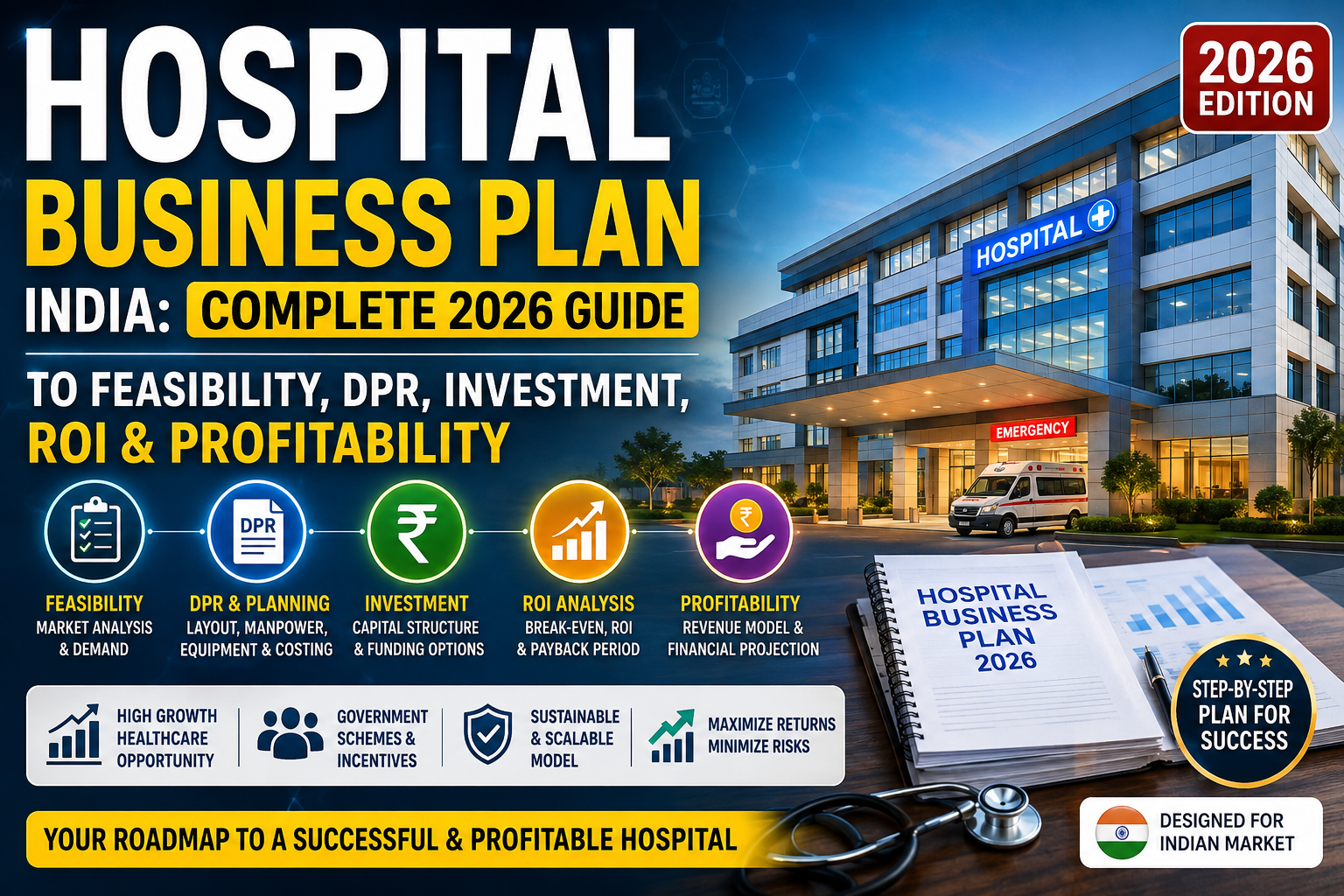
Hospital Business Plan India: Complete 2026 Guide to Feasibility, DPR, Investment, ROI & Profitability
By Dr. D. K. Rai
Future-Ready Hospital Strategist
Hospital Traders | Future-Ready Hospital Movement™
Before You Build a Hospital, Answer One Question
Should you invest in it?
A hospital project can look attractive on paper.
The land may be available.
The location may be growing.
The architect may have designed a beautiful building.
Doctors may be interested.
The promoter may have sufficient capital.
And yet the project can still struggle.
Why?
Because:
A hospital is not successful simply because it can be built.
It needs to be:
needed by the market,
clinically relevant,
operationally efficient,
financially sustainable,
and
capable of adapting to the future.
That is why a serious hospital project should begin with:
Feasibility before construction.
And the business plan is where those decisions come together.
What Is a Hospital Business Plan?
A hospital business plan is a structured strategic and financial blueprint that explains:
- What hospital you intend to build
- Why the market needs it
- Who your patients will be
- Where it should be located
- How many beds you should develop
- Which specialties you should offer
- What infrastructure will be required
- How much capital will be required
- How the hospital will generate revenue
- What it will cost to operate
- When it could reach break-even
- What risks could affect the project
- How the hospital can grow
In simple terms:
A hospital business plan connects the clinical idea to the investment decision.
It should help answer:
“If I invest my capital in this hospital, what assumptions must be true for the project to work?”
That is a much more important question than:
“Can someone prepare a 50-page project report for me?”
The Hospital Investment Decision Framework™
A strong hospital business plan should connect:
MARKET
↓
DEMAND
↓
CLINICAL STRATEGY
↓
CAPACITY
↓
SITE
↓
CAPEX
↓
OPERATING MODEL
↓
REVENUE
↓
OPEX
↓
CASH FLOW
↓
BREAK-EVEN
↓
ROI / CAPITAL PRODUCTIVITY
↓
RISK
↓
INVESTMENT DECISION
If one of these links is weak, the entire project deserves another look.
The Biggest Mistake in Hospital Investment
Many projects follow this sequence:
Land
↓
Architect
↓
Building
↓
Equipment
↓
Doctors
↓
Opening
↓
“Let’s see what happens.”
That’s not a business strategy.
A more disciplined sequence is:
Market
↓
Catchment
↓
Clinical Concept
↓
Bed Capacity
↓
Feasibility
↓
Financial Model
↓
DPR
↓
Hospital Planning
↓
Architecture
↓
Construction
↓
Equipment
↓
Recruitment
↓
Commissioning
↓
Operations
↓
Optimization
The order matters.
Because some decisions become extremely expensive to change once construction begins.
1. Who Needs a Hospital Business Plan?
A hospital business plan is useful for:
Doctors starting their first hospital
Existing hospital owners expanding
Nursing-home owners upgrading
Healthcare entrepreneurs
Family businesses entering healthcare
Investors evaluating a hospital
Developers considering healthcare
Specialty hospital promoters
Greenfield hospital projects
Brownfield hospital projects
Hospital acquisitions
Hospital redevelopment
Multi-phase hospital campuses
The earlier it is prepared, the more useful it can be.
2. What Are You Actually Building?
Before financial modelling, define the hospital.
Are you developing:
- General hospital?
- Multispecialty hospital?
- Secondary-care hospital?
- Tertiary-care hospital?
- Specialty hospital?
- Orthopaedic hospital?
- Mother & child hospital?
- Cardiac centre?
- Oncology centre?
- Surgical hospital?
- Day-care centre?
Each model creates a different:
CAPEX
manpower requirement
equipment requirement
bed mix
OPD model
ICU requirement
OT requirement
revenue model
and:
market catchment.
So:
Don’t build a generic hospital.
Build a hospital with a clear clinical identity.
3. Hospital Market Study
The first financial assumption should not be:
“We will achieve 60% occupancy.”
It should be:
“Why will patients come?”
A proper market study examines:
Population
Demographics
Income profile
Disease patterns
Existing hospitals
Existing beds
Specialty availability
Competitor pricing
Doctor availability
Insurance penetration
Government schemes
Corporate demand
Referral patterns
Patient leakage
Future development
The objective is to identify:
Addressable healthcare demand.
4. Catchment Analysis
A hospital doesn’t have one universal catchment.
Different services attract patients from different distances.
For example:
Emergency
Often strongly influenced by proximity and accessibility.
General Medicine
More locally driven.
Orthopaedics
Can attract patients from a wider area.
Cardiac Surgery
May have a substantially wider referral catchment.
Oncology
Can attract patients from a large geographic area depending on reputation and service capability.
Therefore:
Catchment analysis should be service-specific.
Think:
Total population
↓
Healthcare need
↓
Relevant service demand
↓
Addressable demand
↓
Realistically capturable demand
That final step is where many optimistic business plans become unrealistic.
5. Competitive Analysis
Don’t simply list competitors.
Study them.
For each major competitor, examine:
| Factor | Questions |
|---|---|
| Location | How accessible are they? |
| Beds | What capacity do they have? |
| Specialties | What do they offer? |
| Doctors | Which anchor specialists attract patients? |
| Pricing | What is their market positioning? |
| Diagnostics | What services are available? |
| Insurance | Which payer segments do they serve? |
| Government schemes | Are they participating? |
| Reputation | What do patients say? |
| Strength | Why do patients choose them? |
| Weakness | Where are the gaps? |
Then ask:
Why would a patient choose the new hospital instead?
If you cannot answer that clearly, the business model needs more work.
6. Hospital Bed Capacity
One of the most misunderstood decisions is:
“How many beds should we build?”
The answer should not be:
“The architect says 100 beds fit.”
Nor:
“The investor wants 150.”
Bed capacity should emerge from:
Market demand
Clinical programme
Expected admissions
OPD demand
Occupancy assumptions
Average length of stay
Bed turnover
Specialty mix
ICU demand
Financial capacity
Expansion strategy
Therefore:
Bed capacity is an economic and clinical decision—not merely an architectural decision.
7. Why 100 Beds?
Suppose someone says:
“I want a 100-bed hospital.”
The business plan should immediately ask:
Why 100?
Why not:
50?
75?
80?
120?
The answer should come from the model.
A useful framework is:
Demand → Required Capacity → Financially Sustainable Capacity → Future Capacity
This can lead to a phased model such as:
Phase 1 → 50–75 beds
↓
Phase 2 → 100 beds
↓
Phase 3 → Specialty expansion
But the actual structure must be project-specific.
8. Specialty Mix
A 100-bed hospital with:
General Medicine + Surgery + Orthopaedics
is a completely different business from:
Cardiology + Cardiac Surgery + Critical Care.
Your specialty strategy determines:
- Consultants
- Equipment
- OT
- ICU
- Diagnostics
- Nursing
- CAPEX
- Revenue
- Referral network
- Marketing
- Patient volumes
A useful clinical strategy equation is:
Demand × Doctor Availability × Infrastructure × Differentiation × Economics
Don’t ask:
“Which specialties are popular?”
Ask:
“Which specialties can this hospital deliver exceptionally well and sustainably?”
9. Hospital Feasibility Study
This is where a hospital business plan becomes serious.
A feasibility study should investigate whether the proposed hospital is viable.
It should examine:
Market feasibility
Is sufficient demand present?
Clinical feasibility
Can the proposed services actually be delivered?
Site feasibility
Is the location appropriate?
Technical feasibility
Can the hospital be physically developed?
Operational feasibility
Can it function effectively?
Financial feasibility
Can it generate sustainable cash flow?
Regulatory feasibility
Can it operate within applicable requirements?
Strategic feasibility
Can it differentiate itself?
A Good Feasibility Study Should Challenge the Project
This is one of the most important principles in hospital consulting:
A feasibility study should not be written to prove that the project is feasible.
It should be designed to discover:
Whether it is feasible.
That means identifying:
Strengths
Weaknesses
Assumptions
Risks
Unknowns
Sensitivities
Deal-breakers
That is far more valuable than a report designed only to support the promoter’s original idea.
10. Hospital Business Plan vs DPR vs Feasibility Report
These are often confused.
| Document | Main Purpose |
|---|---|
| Business Plan | How the hospital will work as a business |
| Feasibility Study | Whether the project is viable |
| DPR | How the project will be developed and executed |
| Financial Model | Whether the numbers work under different assumptions |
| Hospital Master Plan | How the physical and functional hospital should develop |
A strong project often needs all of them to connect.
Feasibility asks:
Should we do it?
Business plan asks:
How will it work?
Financial model asks:
Do the economics work?
DPR asks:
How will we execute it?
Hospital planning asks:
How should it physically and operationally function?
11. Hospital Business Plan Format
A professional hospital business plan can contain:
Executive Summary
- Project
- Location
- Concept
- Beds
- Specialties
- Investment
- Financial highlights
Market Analysis
- Catchment
- Demand
- Competition
- Patient profile
Clinical Strategy
- Specialties
- Services
- Bed mix
- OPD
- IPD
- ICU
- OT
- Diagnostics
Site & Project
- Land
- Site
- Development potential
- Planning
- Infrastructure
Operations
- Organization
- Manpower
- Processes
- Technology
- Quality
Financial Plan
- CAPEX
- OPEX
- Revenue
- Working capital
- Cash flow
- Break-even
- ROI
- Sensitivity
Risk
- Market
- Financial
- Regulatory
- Clinical
- Operational
- Execution
Implementation
- Timeline
- Approvals
- Construction
- Equipment
- Recruitment
- Commissioning
Growth
- Expansion
- Additional beds
- New specialties
- New services
12. Hospital DPR
A Detailed Project Report should convert the strategic business model into an executable project.
A good DPR can cover:
Project background
Promoter profile
Market study
Site analysis
Clinical programme
Bed plan
Area programme
Hospital planning
Architecture
Engineering
Medical equipment
IT
HR
Regulatory roadmap
NABH strategy
CAPEX
OPEX
Revenue model
Cash flow
Break-even
ROI
Risk analysis
Implementation schedule
Expansion strategy
The difference between a weak and strong DPR is often not its page count.
It’s whether the document helps someone make a decision.
A decision-ready DPR beats a document-heavy DPR.
13. Hospital Project Cost
One of the most searched questions is:
“How much does it cost to start a hospital in India?”
There is no single honest answer.
Hospital investment can include:
Land
Construction
Architecture & professional fees
MEP
Fire & life safety
Medical gases
Medical equipment
Furniture
IT
Statutory approvals
Pre-opening expenses
Recruitment
Training
Marketing
Working capital
Contingency
Therefore:
Hospital project cost ≠ construction cost.
And:
Hospital project cost ≠ cost per bed alone.
14. What Drives Hospital CAPEX?
Major variables include:
| Variable | Why it matters |
|---|---|
| Location | Land and construction economics |
| Bed capacity | Overall scale |
| Specialty mix | Clinical infrastructure |
| ICU | High infrastructure intensity |
| OT | Equipment + engineering |
| Diagnostics | Equipment CAPEX |
| Imaging | High equipment investment |
| MEP | Critical hospital infrastructure |
| Parking | Site and development requirement |
| IT | Digital infrastructure |
| Quality | Infrastructure/process requirements |
| Expansion | Initial infrastructure headroom |
This is why two “100-bed hospitals” can have dramatically different investment requirements.
15. Total Project Capital
Think of the investment as:
LAND
CONSTRUCTION
MEP
MEDICAL EQUIPMENT
FURNITURE
IT
PROFESSIONAL FEES
APPROVALS
PRE-OPENING
WORKING CAPITAL
CONTINGENCY
=
TOTAL CAPITAL REQUIREMENT
The business plan should make every major assumption visible.
16. Hospital Investment Plan
A promoter should know:
How much equity is required?
How much debt?
What is the promoter contribution?
How much working capital?
How much equipment financing?
How much contingency?
When will money be required?
What happens if construction is delayed?
Capital should be mapped against the project timeline.
Because:
The timing of capital matters almost as much as the amount of capital.
17. Hospital Revenue Model
Hospital revenue can come from:
OPD
IPD
Surgery
ICU
Diagnostics
Pharmacy
Procedures
Day-care
Health packages
Corporate healthcare
Insurance/TPA
Government schemes
The financial model can use simple building blocks.
OPD Revenue
OPD Patients × Average Realization
IPD Revenue
Occupied Bed Days × Average Realization
OT Revenue
Procedures × Average Realization
Diagnostics Revenue
Tests × Average Realization
These are modelling formulas—not guaranteed results.
18. Hospital Occupancy Is Not the Whole Business
A common shortcut is:
“If we achieve 70% occupancy, the hospital will be profitable.”
Not necessarily.
Profitability also depends on:
Average realization
Specialty mix
Length of stay
OT utilization
ICU utilization
Diagnostics utilization
Pharmacy margins
Payer mix
Consumables
Manpower
Utilities
Receivables
Debt
Fixed costs
So:
Occupancy is a KPI—not a complete business model.
19. Hospital Profitability
At a basic level:
Revenue
− Variable Costs
− Fixed Operating Costs
=
Operating Profit
Major cost categories can include:
Doctors
Nursing
Technicians
Consumables
Drugs
Utilities
Maintenance
Housekeeping
Security
IT
Administration
Marketing
Insurance
Finance costs
The business plan should also examine profitability by service line.
For example:
Is the diagnostic centre profitable?
Is the OT being utilized enough?
Is ICU creating value after staffing and infrastructure costs?
Are some services acting as referral engines rather than direct profit centres?
This is much more useful than looking only at total hospital revenue.
20. Hospital Break-Even
Break-even means reaching the point where the hospital’s operating economics cover its relevant costs under the model.
But every hospital’s break-even is different.
It depends on:
Fixed costs
Variable costs
Revenue realization
Payer mix
Occupancy
OPD
OT
ICU
Diagnostics
Pharmacy
Service mix
Financing
A useful conceptual relationship is:
Contribution = Revenue − Variable Cost
and:
Break-even volume = Fixed Costs ÷ Contribution per unit
The “unit” could be defined differently for different hospital models.
Therefore:
There is no universal hospital break-even occupancy.
Anyone giving you one number without understanding your project should be treated cautiously.
21. Hospital ROI
ROI should not be confused with profit.
Consider:
Project investment
Annual operating profit
Cash flow
Debt
Working capital
Asset utilization
Expansion CAPEX
Exit value, if relevant
Common investment metrics include:
ROI
ROCE
Payback period
IRR
NPV
Each answers a different question.
A project can have:
high revenue
but
poor capital productivity.
22. Capital Productivity
This is a question I believe more hospital promoters should ask:
“What am I getting from every rupee invested?”
Suppose:
Project A
Lower investment
Lower absolute profit
Project B
Higher investment
Higher absolute profit
Project B may sound better.
But what if:
Project A produces a stronger return on invested capital?
Then the larger hospital may not actually be the better investment.
Therefore:
The biggest hospital is not automatically the best hospital investment.
23. Hospital Financial Stress Testing
A serious business plan should never show only one scenario.
Build:
BASE CASE
Your most reasonable assumptions.
DOWNSIDE CASE
What happens if performance is weaker?
UPSIDE CASE
What happens if demand exceeds expectations?
Then stress the model.
For illustration:
Occupancy ↓
Revenue realization ↓
CAPEX ↑
Construction delayed
Patient ramp-up slower
Manpower cost ↑
Consumables ↑
Receivables delayed
The exact stress assumptions should be customized to the project.
The principle is:
Don’t invest because the upside case looks attractive.
Invest only after understanding whether the project remains viable under reasonable downside conditions.
24. Hospital Risk Register
Every hospital business plan should have a risk section.
| Risk | Potential Impact | Mitigation |
|---|---|---|
| Weak demand | Low volumes | Validate catchment |
| Poor location | Patient leakage | Site study |
| Excessive CAPEX | Capital stress | Value engineering |
| Slow ramp-up | Cash-flow pressure | Working capital |
| Doctor dependency | Revenue risk | Multi-specialty ecosystem |
| High manpower | Margin pressure | Productivity model |
| Low equipment use | Poor capital productivity | Utilization modelling |
| Regulatory delay | Opening delay | Approval roadmap |
| Construction delay | Interest/carrying cost | Project controls |
| Competition | Lower volumes | Differentiation |
| Payer concentration | Cash-flow risk | Diversified payer mix |
| Poor planning | Operational inefficiency | Functional planning |
25. Hospital Planning Is Part of the Business Plan
This is where many financial consultants stop too early.
Suppose the financial model says:
100 beds.
That number must translate into:
IPD
ICU
OT
Emergency
OPD
Diagnostics
Pharmacy
CSSD
Stores
Kitchen
Laundry
Engineering
Waste
Parking
Administration
and:
Future expansion.
Then test:
Patient flow
Staff flow
Material flow
Waste flow
Emergency flow
Because:
A financially attractive hospital can still fail operationally if it is badly planned.
26. NABH Should Enter the Business Plan Early
Quality should not be added after construction.
NABH’s current Hospital Accreditation Standards 6th Edition state that the hospital accreditation standards apply to healthcare organizations that are operational, have more than 50 sanctioned inpatient beds, and commit to applicable NABH and legal/statutory/regulatory requirements. The standards are intended for the whole organization rather than a single service. (NABH Portal)
The 6th Edition uses ten chapters and includes 639 objective elements, with different categories assessed across accreditation stages. (Nabh)
For a new project, that means the business plan should consider:
Patient safety
Infection prevention
Medication management
Facility safety
Human resources
Information management
Quality improvement
Governance
Patient experience
The correct mindset is:
Don’t build first and retrofit quality later.
27. Ayushman Bharat / PM-JAY
If your hospital’s business model includes PM-JAY, it should be incorporated into the financial and operational strategy from the beginning.
The National Health Authority’s hospital empanelment guidance covers areas such as hospital infrastructure, medical infrastructure, financial details, specialties, manpower, licences and certifications. (National Housing Authority)
That means the business plan should consider:
Eligible services
Infrastructure
Human resources
Documentation
Package economics
Claims
Pre-authorizations
Receivables
Medical records
Operational capacity
PM-JAY should therefore be treated as a payer and operating-model decision, not merely an empanelment checkbox.
28. Regulatory Planning
Hospital regulation is location- and service-dependent.
The central Clinical Establishments portal states that the Clinical Establishments Act has been adopted in 19 States/UTs, including Uttar Pradesh, and all Union Territories except Delhi, as currently listed on the portal.
The Act provides for registration and minimum standards for applicable clinical establishments, and the statutory framework includes requirements relating to facilities, personnel, records and other conditions. (Clinical Establishments)
But a hospital project can involve many additional approvals depending on its:
State
building
services
diagnostics
radiology
pharmacy
blood services
waste
fire systems
and other characteristics.
Therefore:
Never copy a regulatory checklist from another hospital.
Build a project-specific, state-specific regulatory matrix.
29. Hospital Equipment Investment
One of the biggest CAPEX traps is:
Buying equipment because a modern hospital is “supposed” to have it.
Instead evaluate each major equipment decision through:
Demand
Volume
Utilization
CAPEX
OPEX
Staffing
Maintenance
Revenue
Payback
Strategic value
Then decide:
BUY
or
LEASE
or
OUTSOURCE
or
PARTNER
or
PHASE
An expensive machine that sits idle is not a symbol of sophistication.
It is:
Idle capital.
30. Hospital Human Resource Business Model
Your building does not treat patients.
Your people do.
The business plan should consider:
Consultants
Medical officers
Nursing
Technicians
Pharmacy
Quality
Infection control
Hospital administration
Finance
HR
IT
Biomedical engineering
Housekeeping
Security
Maintenance
Front office
The critical question isn’t merely:
“How many people do we need?”
It is:
“What workforce is required to deliver the planned volume safely and efficiently?”
31. Digital Hospital Strategy
The business plan should include:
HIS
EMR
LIS
RIS
PACS
Billing
Pharmacy
Inventory
HRMS
Analytics
Cybersecurity
Backup
Disaster recovery
The objective is not to buy software.
It’s to create:
A digital operating system for the hospital.
NABH’s current ecosystem also includes dedicated digital-health standards, reinforcing the importance of digital systems in modern hospital quality infrastructure. (Nabh)
32. Pre-Opening Strategy
A hospital is not ready when the contractor says:
“Construction complete.”
Before opening, validate:
Equipment commissioning
IT
Utilities
Medical gases
Fire systems
Staff
Training
SOP implementation
Emergency drills
Pharmacy
CSSD
Infection control
Biomedical waste
Documentation
Statutory approvals
Billing
Insurance / TPA
Doctor onboarding
Referral network
Marketing
Then conduct:
Mock Operations
Ask:
What happens if 50 patients arrive at 9 AM?
What happens if three emergencies arrive simultaneously?
What happens if the HIS goes down?
What happens if oxygen supply is interrupted?
What happens if an OT case overruns?
The hospital should be tested before patients test it.
33. Hospital Marketing & Patient Acquisition
A business plan should explain:
How will patients find the hospital?
Potential channels include:
Doctor referrals
Local SEO
Website
Google Business Profile
Corporate relationships
Community engagement
Patient education
Specialty positioning
Health programmes
Digital communication
The key is differentiation.
Don’t market:
“We have 100 beds.”
Market:
“Why should a patient choose this hospital?”
34. Revenue Is Not the Same as Profit
This deserves repetition.
A hospital can have:
₹X crore revenue
and still have weak cash generation.
Why?
Because of:
High salaries
Consumables
Low utilization
Debt
Equipment maintenance
Poor procurement
Receivables
High fixed costs
Inefficient processes
Therefore:
Revenue is vanity if cash flow is weak.
The business plan must understand:
Revenue → Contribution → Operating Profit → Cash Flow → Return on Capital
35. Expansion Planning
A hospital business plan should not stop at Day 1.
Ask:
Can we add beds?
Can ICU expand?
Can OT expand?
Can diagnostics expand?
Can a specialty centre be added?
Can the building expand?
Is the MEP capacity adequate?
Is the site expandable?
Is parking expandable?
Can Phase 2 happen without disrupting Phase 1?
The best time to answer those questions is:
Before Phase 1 is built.
36. The Future-Ready Hospital Business Blueprint™
At HospitalTraders, I would look at a hospital project through this strategic sequence:
MARKET
Is the demand real?
↓
CLINICAL
What should the hospital deliver?
↓
CAPACITY
How much capacity is justified?
↓
PLANNING
How should it function?
↓
CAPITAL
How much investment is required?
↓
OPERATIONS
How will it run?
↓
QUALITY
How will safety and quality be embedded?
↓
DIGITAL
What technology will support it?
↓
FINANCIAL PERFORMANCE
Will the economics work?
↓
GROWTH
How will it evolve?
This is the:
Future-Ready Hospital Business Blueprint™
A strategic framework for thinking about hospital projects before major capital becomes difficult to reverse.
37. The 10 Questions to Ask Before Investing
If you are considering a hospital project, ask:
1. Who exactly are my patients?
2. Why will they choose my hospital?
3. Is this location genuinely strategic?
4. Why this number of beds?
5. Which specialties will drive demand?
6. What is my total capital requirement?
7. What happens if patient volumes are lower than expected?
8. When does the hospital reach operating break-even?
9. What return am I getting on the capital invested?
10. What could make this project fail?
If you cannot answer several of these:
You probably need more feasibility work before construction.
38. The Hospital Investment Red-Flag Checklist
Be cautious when you hear:
“The population is huge, so patients will come.”
“Every hospital in this area is full.”
“The architect says we can fit 100 beds.”
“We’ll calculate ROI after opening.”
“We’ll take care of NABH later.”
“We’ll buy the equipment now; demand will come.”
“Doctors will join after the building is ready.”
“Working capital won’t be a problem.”
“Occupancy will reach 70% quickly.”
“The government scheme will fill the beds.”
These are not necessarily wrong.
But each requires:
Evidence.
39. What Should a Hospital Business Plan Deliver?
At the end of the process, the promoter should have clarity on:
Hospital concept
Target market
Catchment
Site suitability
Bed capacity
Specialty mix
Clinical programme
Hospital planning
CAPEX
OPEX
Revenue model
Working capital
Cash flow
Break-even
ROI
Risk
Regulatory roadmap
NABH strategy
Equipment strategy
HR strategy
IT strategy
Implementation timeline
Expansion strategy
Most importantly:
A clearer investment decision.
40. GO, REWORK, WAIT OR WALK AWAY?
A hospital business plan should ideally lead to one of four decisions.
🟢 GO
Demand is credible.
The concept is differentiated.
The site works.
The economics are reasonable.
Execution capability exists.
🟡 REWORK
Demand exists, but:
- Bed capacity is wrong
- Specialty mix needs modification
- CAPEX is excessive
- Financial model needs optimization
🟠 WAIT
Important assumptions remain unvalidated.
More research is required before capital is committed.
🔴 DO NOT INVEST
The project has fundamental problems that cannot currently be justified.
This is important:
A good consultant should sometimes tell a promoter not to build.
Because avoiding a bad investment can be more valuable than winning a consultancy assignment.
The Hospital Business Plan Master Checklist
Before calling a hospital project “investment-ready”, review:
STRATEGY
□ Concept defined
□ Market defined
□ Differentiation defined
MARKET
□ Catchment analysed
□ Competitors mapped
□ Demand estimated
□ Patient leakage assessed
CLINICAL
□ Specialties defined
□ Bed mix defined
□ OPD model
□ ICU strategy
□ OT strategy
□ Diagnostics strategy
SITE
□ Accessibility
□ Land suitability
□ Development potential
□ Parking
□ Expansion
FINANCIAL
□ CAPEX
□ OPEX
□ Working capital
□ Revenue model
□ Cash flow
□ Break-even
□ ROI
□ Sensitivity
OPERATIONS
□ HR
□ Procurement
□ Pharmacy
□ CSSD
□ Quality
□ IT
□ Patient flow
REGULATORY
□ State-specific regulatory matrix
□ Building approvals
□ Fire
□ Applicable clinical establishment registration
□ Specialty-specific approvals
QUALITY
□ NABH strategy
□ Infection control
□ Patient safety
□ Quality indicators
IMPLEMENTATION
□ DPR
□ Timeline
□ Construction
□ Equipment
□ Recruitment
□ Commissioning
FUTURE
□ Expansion
□ Additional beds
□ New specialties
□ Infrastructure headroom
An Illustrative Example
Imagine a promoter says:
“I want to build a 100-bed multispecialty hospital.”
The initial idea looks straightforward.
But the feasibility process discovers:
- The primary catchment is already heavily served.
- One specialty has substantial unmet demand.
- Another proposed specialty has insufficient doctor availability.
- The original equipment list creates excessive CAPEX.
- A phased approach can reduce initial capital exposure.
- The site has expansion potential.
- The original bed mix needs modification.
The result might be:
Original idea
100-bed generic multispecialty hospital
↓
Market validation
Demand concentrated in selected specialties
↓
Clinical redesign
Stronger specialty-led model
↓
Capacity redesign
Phased bed deployment
↓
CAPEX optimization
Delay/avoid low-utilization equipment
↓
Financial stress test
Test slower ramp-up
↓
Final project
More focused and potentially more resilient model
This is an illustrative example, not a claim about a specific client project.
The point is:
Feasibility should change the project when evidence says the project needs to change.
The Most Expensive Hospital Mistake
It isn’t:
Choosing the wrong tile.
It isn’t:
Buying the wrong furniture.
It isn’t even:
Making a construction mistake.
The potentially most expensive mistake is:
Building the wrong hospital correctly.
A beautiful hospital in the wrong market is still the wrong investment.
A technically excellent hospital with the wrong specialty mix can still struggle.
A high-revenue hospital with poor capital productivity can still disappoint investors.
A hospital with excellent doctors but weak operations can still underperform.
Therefore:
Hospital investment starts with strategic clarity.
What a Hospital Business Plan Should Really Give You
Not merely:
A report.
Not merely:
A spreadsheet.
Not merely:
A DPR.
But:
A better decision.
It should help you understand:
What to build
Where to build
How much to build
How much to invest
How to operate
How to generate revenue
What could go wrong
How much downside you can tolerate
When to expand
And whether you should proceed at all
Hospital Traders: From Investment Idea to Future-Ready Hospital
At Hospital Traders, hospital projects can be approached as a connected journey:
Feasibility
→ Business Plan
→ DPR
→ Hospital Planning
→ Architecture & Infrastructure
→ NABH Strategy
→ Equipment
→ Pre-Opening
→ Hospital Transformation
The philosophy is simple:
Don’t begin with construction. Begin with clarity.
Future-Ready Hospital Success Score™
One practical way to begin that conversation is through the:
Future-Ready Hospital Success Score™
A strategic assessment framework that examines areas such as:
Market & Location
Hospital Concept
Bed Capacity
Clinical Mix
Financial Feasibility
Hospital Planning
Infrastructure
Equipment
Manpower
Quality / NABH Readiness
Digital Readiness
Expansion Potential
It is not a guarantee of project success.
It is not a substitute for detailed technical, legal or financial due diligence.
Its purpose is simpler:
Identify the important questions before the expensive decisions.
When Should You Prepare the Business Plan?
Ideally:
Before buying land
or at least before making an irreversible land commitment.
It is also useful:
Before approaching lenders
Before raising investment
Before finalizing bed capacity
Before appointing the architect for detailed design
Before major equipment procurement
Before hospital expansion
Before acquiring an existing hospital
Because the earlier a strategic assumption is tested:
the cheaper it usually is to change.
Before You Invest Crores, Validate the Hospital
If you are planning a:
🏥 New hospital
🏥 50-bed hospital
🏥 100-bed hospital
🏥 150+ bed hospital
🏥 Specialty hospital
🏥 Hospital expansion
🏥 Brownfield redevelopment
🏥 Healthcare investment
don’t begin with:
“How much will construction cost?”
Begin with:
“Is this the right hospital to build?”
Then validate:
Market
Catchment
Clinical model
Capacity
Site
CAPEX
Revenue
OPEX
Working capital
Break-even
ROI
Risk
Planning
Quality
Expansion
Get Your Hospital Project Feasibility Assessment™
If you are seriously evaluating a hospital project, you can explore a structured:
Future-Ready Hospital Project Feasibility Assessment™
The assessment can help examine the major assumptions around:
Market & Catchment
Site & Location
Hospital Concept
Bed Capacity
Clinical Mix
CAPEX
Revenue Model
Break-Even
ROI / Capital Productivity
Hospital Planning
NABH Readiness
Equipment Strategy
HR
Digital Infrastructure
Expansion Potential
The objective isn’t to tell you what you want to hear.
It is to help you identify:
What needs to be validated before major capital is committed.
Explore Your Hospital Project →
Hospital Planning Masterclass | Learn Hospital Planning, Design & Project Management –
A Final Note for Hospital Promoters
A hospital may become one of the most significant capital investments you ever make.
So don’t let the first major decision be:
“Which architect should I hire?”
Your first major decision should be:
“What hospital should I build—and why?”
Then ask:
Is the market there?
Is the site right?
Is the capacity justified?
Is the specialty mix sustainable?
Is the investment affordable?
Is the financial model resilient?
Can the hospital operate efficiently?
Can it meet applicable regulatory and quality requirements?
Can it grow?
And finally:
“If I had not already fallen in love with this project, would the evidence still convince me to invest?”
That is the mindset of a serious hospital investor.
ABOUT THE AUTHOR
Dr. D. K. Rai
Future-Ready Hospital Strategist
Founder — Hospital Traders
Founder — Future-Ready Hospital Movement™
Focused on:
Hospital Feasibility • Hospital Business Planning • Hospital DPR • Hospital Planning • Hospital Setup • NABH Consultancy • Hospital Expansion • Hospital Transformation
HOSPITALTRADERS
Hospital Planning | Feasibility | DPR | NABH | Future-Ready Hospital Transformation
Plan Better. Build Smarter. Operate Stronger. Grow Profitably.
Frequently Asked Questions
What is a hospital business plan?
A hospital business plan is a strategic document that connects the hospital concept, market, clinical model, investment requirement, operating model, revenue, costs, cash flow, risks and growth strategy.
What is included in a hospital business plan?
It typically includes market analysis, catchment, clinical strategy, bed capacity, site, hospital planning, CAPEX, OPEX, revenue model, working capital, break-even, ROI, risk analysis and implementation strategy.
What is the difference between a hospital business plan and a DPR?
A business plan primarily explains how the hospital will work as a business and investment. A DPR translates the project into a detailed development and execution plan. A feasibility study focuses on whether the project is viable.
What is a hospital feasibility report?
It is a structured assessment of whether a proposed hospital is commercially, clinically, technically, operationally and financially viable under stated assumptions.
How is hospital ROI calculated?
ROI depends on how the investment and return are defined. A proper model should distinguish operating profit, cash flow, debt, working capital and invested capital rather than relying on a single generic formula.
What determines hospital profitability?
Major factors include patient volume, realization, specialty mix, occupancy, OT and ICU utilization, manpower, consumables, equipment utilization, payer mix, fixed costs and working capital.
How do I calculate hospital break-even?
Break-even depends on fixed costs, variable costs and contribution. It should be calculated using the hospital’s actual revenue and cost structure rather than a universal occupancy percentage.
Should I buy land before preparing a hospital feasibility study?
Ideally, major land commitments should follow sufficient due diligence and strategic validation. A site that looks attractive as real estate may not be suitable for the proposed hospital.
How many beds should a new hospital have?
There is no universal ideal number. Bed capacity should be derived from demand, clinical strategy, utilization assumptions, capital availability and future expansion.
Is NABH part of a hospital business plan?
It should be considered when relevant to the hospital’s quality and market strategy. NABH’s current Hospital Accreditation Standards apply to operating healthcare organizations with more than 50 sanctioned inpatient beds that commit to the applicable standards and legal/regulatory requirements. (NABH Portal)
Is PM-JAY relevant to hospital financial planning?
It can be if the hospital intends to participate in the scheme. The NHA empanelment framework includes hospital infrastructure, medical infrastructure, specialties, manpower, licences/certifications and financial information among the areas considered. (National Housing Authority)
Does every hospital have the same licensing requirements?
No. Requirements vary with location, services, size and applicable laws. For example, the Clinical Establishments framework is currently adopted in specific States/UTs rather than uniformly across India, so a project-specific regulatory review is important.
The One Sentence I Want Every Hospital Promoter to Remember
A hospital business plan should not convince you to build a hospital. It should help you decide whether the hospital deserves to be built.
Hospital Traders | Future-Ready Hospital Movement™
Before you build. Validate.
Calculate Space , Investment & ROI by Using Free Calculators
Must read